
greenSANE was created to demonstrate that true energy transition does not end with renewable energy generation.
We believe clean energy must originate from sustainable materials throughout its supply chain. That is why we implement the core principles of the Circular Economy (GOZ) and European Circular Economy Action Plan (CEAP) standards, providing a second life to electric vehicle (EV) batteries.
Under the Circular Economy Action Plan (CEAP 2020) and Regulation (EU) 2023/1542 on batteries and waste batteries, the foundational priority is:
👉 reuse prior to recycling.
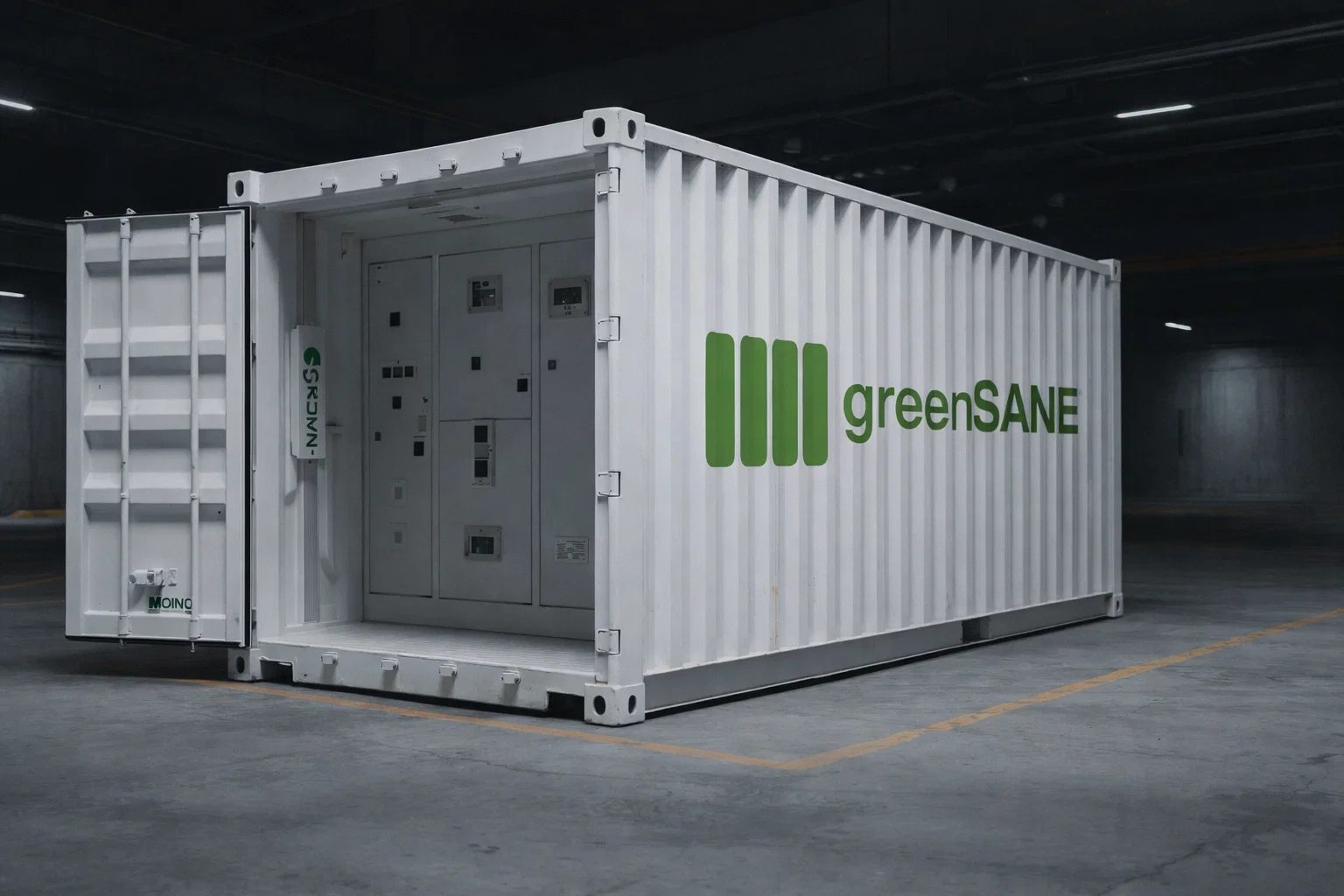
greenSANE applies this principle directly in practice — rigorously testing every battery cell and pack sourced from electric vehicles, and qualifying viable modules for second-life reuse inside stationary second-life BESS (Battery Energy Storage Systems).
As a result, we:
Extend battery operational lifespan by an additional 7–10 years before sending materials to final recycling,
Substantially decrease demand for newly mined primary lithium-ion raw materials,
Reduce lifecycle CO₂ emissions by up to 60–80% across the total energy storage lifecycle.
This represents genuine, measurable Circular Economy implementation — not just declarations.
By repurposing high-grade EV battery cells, the capital cost of second-life energy storage systems is, on average, 35–45% lower compared to BESS architectures manufactured exclusively with new cells.
A lower capital barrier means that:
Solar PV and wind farms can manage generation surpluses and mitigate curtailment penalties more cost-effectively,
Small and medium-sized enterprises (SMEs) can shave peak demand charges and stabilize daily energy consumption,
Energy cooperatives, municipalities, and residential communities can directly participate in the decentralized energy transition.
In partnership with EneGIVE, we also offer an Energy-as-a-Service (EaaS) operational model, enabling enterprise clients to deploy BESS assets with zero upfront capital expenditure (CapEx) — inclusive of full maintenance and 24/7 telemetry monitoring.
During peak production windows, solar PV and wind assets are frequently instructed to limit output — a systemic inefficiency known as renewable curtailment.
greenSANE battery energy storage systems allow grid operators and asset owners to capture and store this surplus clean power instead of wasting it, directly advancing the targets set by EU directives RED II and RED III.
Direct operational benefits:
Increases renewable generation fed into the grid rather than lost to curtailment,
Decreases reliance on fossil fuel peaking plants and cuts Scope 1 & 2 emissions,
Improves financial yields and overall ROI for renewable energy projects.
Every stored megawatt-hour represents a tangible milestone toward a zero-emission economy.
Thanks to modular engineering and flexible capacity scaling, greenSANE BESS units are ideal for energy cooperatives, multi-family residential buildings, and localized microgrid networks.
This provides practical execution of key energy policies:
EU RED III Directive, which actively promotes energy communities and localized self-consumption,
National Renewable Energy Regulations, supporting the deployment of decentralized energy management systems.
Deploying greenSANE storage systems:
Drives onsite self-consumption of locally generated clean power,
Reduces expensive peak electricity purchases from the utility grid,
Stabilizes distribution networks and mitigates local overvoltage trips.
This is true circular energy — localized, clean, resilient, and accessible.
A cornerstone of our circular battery supply chain is our strategic cooperation with Eneris B&R — one of Europe’s leading battery recyclers.
Under our joint Letter of Intent (LoI), Eneris B&R:
Supplies greenSANE with retired EV battery packs that meet strict technical health (SOH) thresholds,
Receives battery assets back at the end of their second-life operating cycle for complete material recovery and recycling,
Collaborates with us to close the circular loop: “Recycler → Repurpose → BESS Operator → Recycler”.
This represents a benchmark model for Circular Economy execution and integrated supply chain management within the European battery sector.
All greenSANE energy storage architectures are pre-engineered for seamless integration with the EU Digital Battery Passport, which is mandatory under Regulation (EU) 2023/1542.
Key compliance advantages:
Every module and battery pack features fully documented cell provenance, SOH health parameters, and operational telemetry history,
Enables accurate reporting of embedded carbon footprint and raw material recycling efficiency rates,
Provides corporate clients with empirical data to satisfy strict ESG audits and CSRD Directive (Directive 2022/2464) reporting requirements.
greenSANE delivers complete environmental data transparency, transforming sustainability reporting from a paperwork exercise into auditable operational facts.
| Key Performance Metric | Environmental & Economic Impact | Unit |
|---|---|---|
| Repurposed EV Battery Module Yield | Up to 80% qualified for second-life BESS assembly | tons/yr |
| BESS Carbon Footprint Reduction | 60–80% reduction compared to prime new cell manufacturing | tCO₂e/MWh |
| System Capital Cost Reduction | 35–45% savings vs. newly manufactured BESS units | % CapEx |
| Renewable Curtailment Mitigation | 10–30% recovered solar/wind energy | MWh/farm |
| Extended Battery Asset Lifespan | +7–10 years secondary operational lifespan | years |
| Active Circular Supply Chain Partnerships | ≥3 core recycling & manufacturing partnerships | — |
For greenSANE, the Circular Economy is not an industry trend — it is the foundation of our technology and system engineering philosophy.
We believe circularity in the energy sector goes far beyond end-of-life recycling: it is about retaining resource value for as long as possible across technical, environmental, and economic dimensions.
By giving EV batteries a second life,
we give renewable energy a second chance,
and provide a sustainable future for our planet.
Regulation (EU) 2023/1542 concerning batteries and waste batteries (including EU Battery Passport mandates)
European Circular Economy Action Plan (CEAP 2020)
EU RED II / RED III Directives – Renewable Energy Communities & Grid BESS Integration
CSRD Directive (Directive 2022/2464) – Corporate Sustainability Reporting Standards
EU Governance of the Energy Union & Climate Action Frameworks
What if we could give used EV batteries a second...
Read More ------
As energy demand rises and the urgency for sustainable solutions...
Read More ------
Introduction Diesel prices Cost per 100 km Why EV PV...
Read More ------